Monday, 17 June 2024

(REVIEW) 10 major, Diamond Setting problems of a new ring. => 17 photos

 This is a good rendition of a "Computer Design", hopefully the finished ring should look like this. Sometimes the completed ring is not what we always expect. 
This essay is about just what can happen.


  The "side view" shows the correct height of the center stone with the Culet being nicely exposed.

  Here are the shoulder stones (hopefully) being set and the claws holding the diamonds. There are even an additional ornamental beads placed along the shoulder.
 
  This 'top view' shows the high polish of the mount in every section of the ring.
 For a better perspective of what the center diamond we will be using, here is the appraisal envelope. It is best to weigh the diamond loose in describing all of the attributes of the large diamond.

  The very first thing that must be done is to drill out the holes for each of the shoulder diamonds.

 Every piece of extra metal from the casting (that is remaining), should be cleaned & filed.
 
   The 'process of sizing' of the ring must be completed in this 'rough state'. Never do this after the stones have been set. Every indentation of the ring MUST be cleaned...NOW!

"HERE ARE THE MANY PROBLEMS"

 1) The sides of the center stone claws haven't been accurately cleaned. There are many areas of the 'basket' still need much cleaning.

2) Here are two areas that are of much concern to to this author and Diamond Setter. The claws are too high above the girdle of this 1.50 carat diamond. The customer might just cut her finger as she is wearing it.
The 4 claws-prongs must NEVER ever exceed the 'Table Facet' height.

3) The process of cleaning with a file, was not even close in being acceptable.

4) The "Rhodium Plating" in finishing, was 'just barely mediocre' to say the least. 

5)There was many areas where the plating went beyond the stone setting and not noticed.

       (There was no indication (to me) of any attempt to clean the 'corners of the ring').


   6) The inside section where the 4 diamonds were set, hadn't been "Bright-Cut". (The diamond-setting tradesperson needs more training in his craft).
  
 7) There are still marks on the side of the claws, why is this?
  
     8) Why were these claws left so high and what was it's purpose?

                   (On each claw there is a rim of metal around each bead.) 


   9) Can you see the indentations of the bead-burnisher where it touched the side-metal? It wasn't noticed, nor was it repaired.

 10) There is even more 'poor Plating' above where the 4 diamonds have been set.
  
  In my estimation: The cleaning, stone setting & Rhodium Plating is just not acceptable. If I was the client, I would be very disappointed!! But I would show the person the many errors in completing this ultra-expensive ring.
 

Sunday, 16 June 2024

AMAZING DIAMOND INFORMATION: => 25 photos


  Here are some amazing information displays of Diamonds. I found these notes and think this email is pertinent to your learning of a diamond.
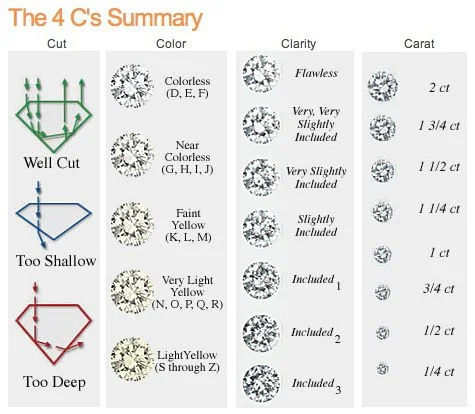
Everyone knows what the famous 4C's are, they are here in the greatest detail.
"Cut, Colour, Clarity and Carat".
 These categories are not just in simple words, all through this essay are colourful pieces of information.


  Here are $1.3 million dollars of diamonds.
 
   Here are two shapes of stones "Round & Princess-Cut", also known as "Square".
 
 This photo displays what a Diamond Polisher is doing. This skilled craftsperson is holding a diamond crystal in a "Dobb" and allowing a revolving steel wheel that has literally diamond-dust grinding facets to the diamond crystal. 
 The lubricant that is on the surface of the wheel has minute particles of diamonds that have been polished off and this dust and only this dust will cut and shape the diamond. 
 No other granules known will help the craftsperson to do this kind of 'shaping'.


  From a diamond crystal as shown, two diamonds will come from this one stone. The 'planning stages' of finding where the grain of the stone lays, is an integral part of being a Diamond Polisher.

  Hidden inside every 'diamond crystal' are two diamonds as shown here. It is the task of the Diamond Polisher to expose these two stones to be seen in all of its glory.
 From a crystal initially weighing 11.121 carats, these two stones now weigh 5.372 carats in total weight.

  The Diamond Polisher must now look into every crystal to determine where the best angle will be to 'cut & saw' the stone. The main concern is to locate where the "grain" is located, if not located accurately, any pressure will break or shatter the diamond in half. Thus leaving the crystal into literally diamond 'dust and shavings'.

  The proper name for this crystal is a "Boart". This is what every diamond looks like when it's removed from the ground.

From every crystal, two newer diamonds can be created (as shown). 


 These 5 diagrams explain in detail how the progression of Sawing and Faceting a gemstone occurs. The correct name for "Rounded" is "Girdling". It is when the Polisher actually starts the detailed 'shaping' process.
  The name "Lopped" is the start of the "Faceting process" into an 8-sided & faceted stone. The name "Finished" is when all of the 57 facets are then created into a fully designed diamond.


  These are the ideas on how to decide how to select and choose a new diamond.

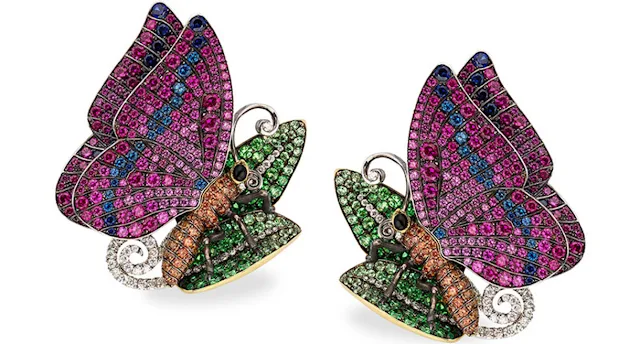
 This is a genuine set of diamond butterflies using the Pave' method of stone setting.

 Here the full-colour range of diamonds starts from "White" to "Intense Pink".


  After all of your stone selection has been completed, these diamonds can be made into fine-quality jewellery.


   The "4 C's" are explained here in the greatest detail. The 'COLOUR' is being shown in great looking multi-colours. 
 Here are the 10 shapes of Diamonds. The "Round" shape is the most common in today's market.
 This is one of the most important essays that I've come across lately. I felt that it needs to be explored in full and shared with  YOU.
 As I'm Canadian, the spelling of 'Colour" has not been misspelt all through this essay.


Saturday, 15 June 2024

Bead Burnishing and Bright-Cutting on metal => 16 photos

 These two topics are so important, that they must be reviewed often, do you agree???

Just what does a Bead-Burnisher do while burnishing a Bead? The answer is quite simple. It 'rounds' off the tip of a sharpened point of a newly created Bead. The Burnisher has an inside dish that covers that one bead. When pressed down and rotating it will create a 'little ball' that will cover the "Girdle" of the stone. 


 I use all of the Onglette gravers to "Bright-Cut" in the metal. There is no other way to create this design & pattern.


  I use only Onglette gravers #1 & #2 to initialize any 'abstract' graver cutting. Then following, with a highly polished graver to further any "Bright-Cutting". I personally try to avoid any cutting with Flat graver.

 When I 'Pre-Set' the stones, this will give more strength to the beads and give the 'stone setting' a more polished finish.


 Even after all of the stones have been set. The applied "Bead-Burnishing" process gives more lustre to the overall appearance.

 This initial photo is the epitome of being made fantastic for the wearer to view. 


 There must be a separation of the Hand-Created beads. If not, the two beads will not look complete. The only method is using a Graver of #1 width to separate the metal beads.

 Please note that EVERY BEAD must be burnished thoroughly before setting that stone. If you burnish a stone after stone setting, the chances of stone breakage will escalate.
 
  To repeat the photo that I used at the beginning of this essay. Please burnish the bead GENTLY on the softer stones. These stones are Emeralds, Cubic Zirconia, Amethyst and other stones that are below Mohs Scale of 6. 

 The side of these Bead-burnishers can be removed on your oilstone. The chances of having the 'curved edge' break or damage that softer stone are extremely easy. 
 
 Here is how you can save your stones by removing a section of the outside edge of the beading tool.