Making time-pieces, or watches is not a new art, or skill. It's been around for more than 4 centuries. I just found this book in my vast library a few days ago.
Therefore this is a "gift for YOU", the readers of Ganoksin-Orchid! These watches are just fantastic in their artistic creativity. I felt that I must SHARE THEM WITH YOU!
I will share some of the facts on each watch as its being shown, including the date & country of manufacture. I want to make this "historical watch exhibition" as informative as possible.


OVAL WATCH OF THE LATE RENAISSANCE
South German (Augsburg or Nuremburg) maker Carl Schmidt signed this movement, circa
1600 A.D. Its plain gift metal case is perforated at the back to permit the bell to be heard. But the bell strikes only one to six, a division of the so called "Italian hour" (one to twenty-four). The silver dial is engraved with the Sun and lightning emblems.
For centuries, German watches of this type were miscalled "Nuremberg eggs" due to misreading of ueurlein. (little watch) into eyerlein (little egg).

OCTAGONAL ROCK CRYSTAL WATCH
Dresden maker Johann Postdorfer signed this movement, c. 1620. The clear rock crystal case in its lower part is carved as a star with beveled edges. The rock crystal lid is cut in double star, mounted in a framework of enameled gold. Dial is gold with white hour ring and enameled center.


ASTRONOMICAL XVII CENTURY WATCH
This was made in 1650 A.D. specifically for the Turkish market and bears Turkish dial numerals. It shows the phases of the Moon, in three fan-shaped openings. Gilded oval case is engraved with a floral design. 
GILDED BRASS ASTRONOMICAL WATCH
This was made by an unknown German maker in 1650 and designed to for the Turkish market. The gilded metal case is unadorned. A complex astronomical dial shows time of day, day of week and phases of the moon. In such astronomical watches of the pre-balance spring period, time of the day was often less accurate than indications of week and month. 
ROCK CRYSTAL SWISS WATCH
Signed by famed Geneva craftsman Denis Bordier, circa 1660, this octagonal watch has a finely faceted translucent case set in a silver frame. The movement employs a catgut pull on fusee, and has an unusual balance cock.
This silver watch has a movement signed by "Pierre Duhamel", circa 1660 of Geneva. The case is chased on sides and back with flowers and foliage., and has a crystal cover and circular white enamel dial. Fusee movement is comparatively thin. The case has an outside keyhole cover.


GILDED BRASS CLOCK-WATCH
The gilded bras case is engraved and pierced with a design of birds and foliage. made by Johann Wulky of Breslau, circa 1660, it is characteristic of early German watches. Though similar to previous watches of that time, this watch is more recent. This watch emphasizes the differences between Nuremberg and Augsburg, then major cities and other watch producers, and those who are more advanced.

FULLY ENAMELLED DRESS WATCH
This was made in 1665 A.D. This XVIth Century German watch, was signed by Jeremias Flug of Passau, circa 1665. the movement employs a fusee chain (a steel chain which is a successor to the gut-cord. The "Bassine" (rounded edge case) and is enameled inside and out, front has silver-set turquoises; back enamel depicts the Departure of Ulysses.
XVII CENTURY GOLD ENAMELLED DRESS WATCH. (see more details below)
This was made sometime between 1670-1680! This was made by "Husud le Puisne" circa1665-1723 his signature appears in a lateral cartouche.



PAIR-CASE WINDOW AUTOMATONWATCH


GEORGIAN PAIR-CASE REPEATER
ENGLISH GOLD and PRECIOUS STONE WATCH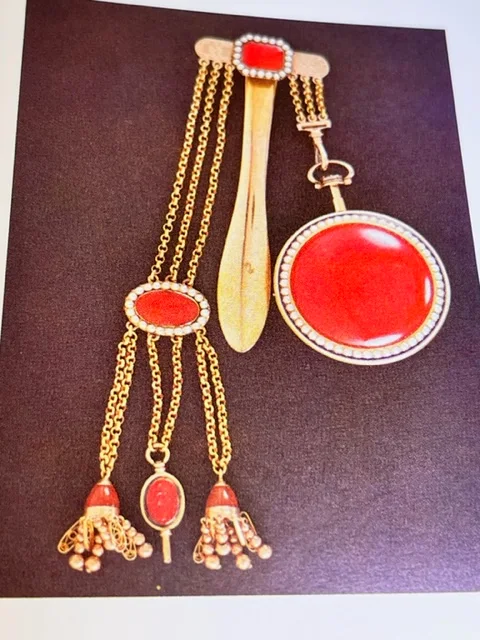

LOUIS XVI RING-WATCH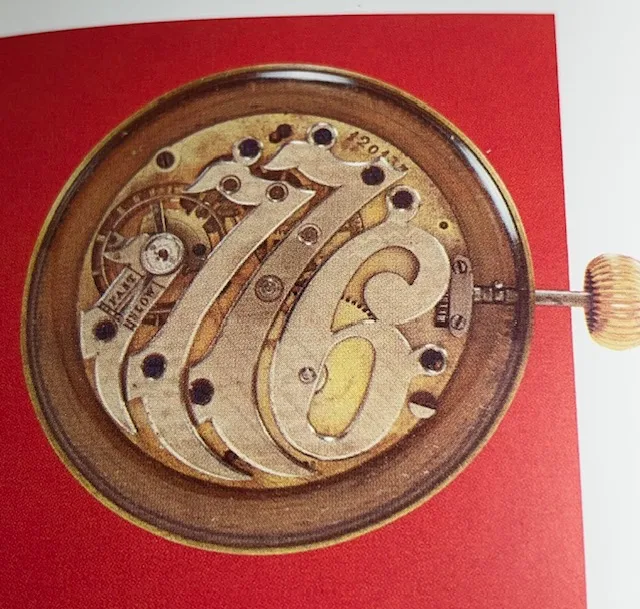
LOUIS PHILIPPE DRESS WATCH

XVII CENTURY GOLD ENAMELLED DRESS WATCH
Thomas Williamson of London signed the catgut and fusee' movement, no hairspring, circa 1670-1680. The bassine case is painted inside and out in multicolored enamel by Huaud le Puisne' (1665-1723), whose signature appears in a lateral cartouche. He was an eminent member of a famed dynasty of early Geneva painter in enamel. There are mythological landscapes inside, contemporary landscapes on lateral panels. The back painting shows "Cleopatra and the Asp"

XVII CENTURY GOLD ENAMELLED DRESS WATCH
This movement was created in 1676-1680. The dial represents "SALOME WITH THE HEAD OF JOHN THE BAPTIST". The Lateral cartouche bears the great masters signature "Messrs. Huaud le Puisne".

PAIR-CASE ASRONOMICAL CLOCK-WATCH.
This watch is signed by Abraham Pattey of Geneva, c.1680. The gilded, engraved dial has a silver hour ring, concentric numeral rings denoting days of the month with aperture for phases of the moon. Fan-shaped windows show both the day and month. Hours are struck on a large bell.

RESTORATION PAIR-CASE CLOCK-WATCH
Circa 1685 by the the famed London, England. "Edward East" signed this alarm movement. The metal inner case is pierced & engraved with a floral design.

The outer is leather covered pique with silver stars & crescents. It is pierced to enhance the bell sounds. It is engraved & chased silver dial with two hands.

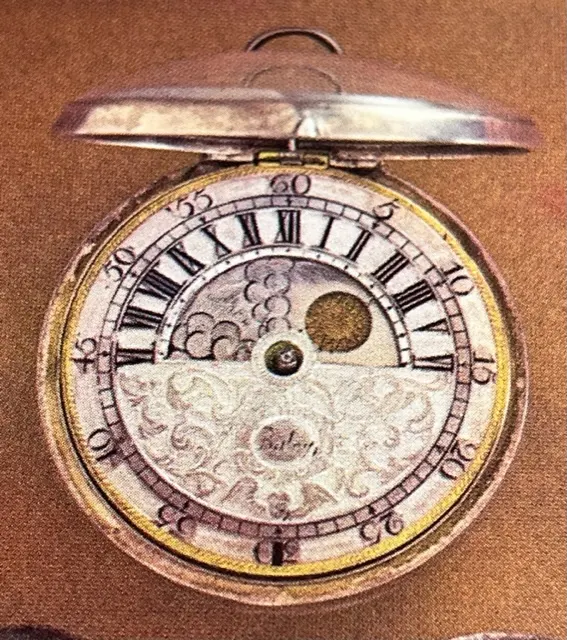
SUN AND MOON WATCH
This watch was made by Thomas Baley of London, England. This was made in 1690 and uses an early technique to show hours & minutes in this pair-case watch with a revolving disc, turning in a semicircular.
An engraved sun bear a small pointer for daylight hours. Outer is covered with shagreen leather Silver Window Automaton

SILVER WINDOW AUTOMATON WATCH
This watch was created in circa, 1700. Created by Denis Miroglio of Geneva. The 5 face(s) are inter-changeable as the hands rotate. Interesting concept? The back (unseen) is richly engraved with the arms of the German Prince Fugger-Babenhausen.

PAIR-CASE WINDOW AUTOMATONWATCH
Baltazard Faure of Geneva made this Swiss silver watch in 1702. The 5 faces are changed just by depressing the the pendant-Gold hands. Interesting?

LOUIS XIV PAIR-CASE CLOCK WATCH
The pierced and engraved outer case is covered by richly pique' leather, decorated with gold pins. The movement, signed by David Terrier of Paris, 1700. This mechanism strikes the hours on a bell.

FRENCH PAIR-CASE REPEATER
This typical of the bulbous French watches of the late and early XVIII century. called "olgnon" or "onion". This quarter repeater was made by Couzier of Paris, circa 1730. It is abundantly covered by silver pins

GEORGIAN SILVER PAIR-CASE WATCH
This Tortoise shell inlaid with silver pique' with silver pins, covers the plain outer case. Inner case is plain silver and houses a movement signed "Ben Booth fecit," London, England, circa 1720-1730.

London maker "Isa Rodet's" signature, circa 1730-1740 appears on the movement, which repeats hours and quarters. Inner and outer case, both in gold, are finely engraved and pierced. The outer is "repousse' with medallions, scallop shells and flowers.

XVII CENTURY BRASS ALARM WATCH

This is called by some a "Hermaphrodite Watch". This unusual French timepiece, has a movement that winds on a male "arbor" and then accepts a female key. The alarm is regulated by a dial disk, in turn controlled by a mechanism with a females winding hole.
Signed by Isaac Themeguex, circa 1740. It has been said that this watch is to horology what the Louvre hermaphrodite is to Greek sculpture.

PAIR-CASE "JAPANESE" WATCH

This is an English made watch, for the Japanese market. It was made in 1750, it has steel hands with brass & silver dial with decimal & duodecimal Japanese fashion. Back plate is highly decorated in the Oriental manner.

GEORGIAN GOLD AND AGATE WATCH

London maker George Dutens produced this fine watch in 1750. It's case is actually a hollowed out Agate that houses a small movement. The front bezel & has a mottled Agate and Jasper panels. Dial is white enamel with gold bands.

The Bloodstone case is set in gold with a diamond thumbpiece and smaller diamonds on the upper side.. Back of the case is hollowed out of one piece of Bloodstone.
London, England maker George Dutens signed the movement.


SILVER SEDAN CHAIR WATCH
German maker Johann Gottfried Kriedel of Bautzen signed this movement in 1740. This has an alarm and repeater arrangement with three winding arbors for the three mainsprings.
The three winding holes are marked "W" weckt (alarm), "S", schlaegt (strike) and "G" geht (go). There is decorated with engraved & pierced follage scrolls as well as cartouches.


GOLD, AGATE and RUBY DRESS WATCH

ENAMEL AND GOLD BEDSIDE WATCH
This English clock-watch from 1760 strikes hours and quarters and has a center second hand.
The case is pierced and engraved with Geneva enamel, it has flowers inlaid in gold. The case and Bezel hear two circles of Rubies & Pearl. The clasp is Emerald.

LOUIS XV SEDAN CHAIR CLOCK-WATCH
The alarm movement of this French watch is signed by Julien Le Roy of Paris, circa 1750. It is a quarter repeater on a string with a silver acorn, it has an alarm and calendar adjoining dials. Much of the silver and Bezel are pierced and engraved. A swivel suspension enables it to follow the movements of the sedan chair and thus avoiding injury.

The reverse of this English watch is signed "Clay" from 1740-1750. The dial is of gilded Brass.

James Cox of London, England signed the movement circa 1760. This has a quarter repeater. The outer case is decorated with translucent Moss Agate panels in Louis XV style. it's engraved and studded with Rubies & Emeralds. The Bezel also has Moss Agate panels surrounded with Rubies.

ENGLISH GOLD AND ENAMEL WATCH

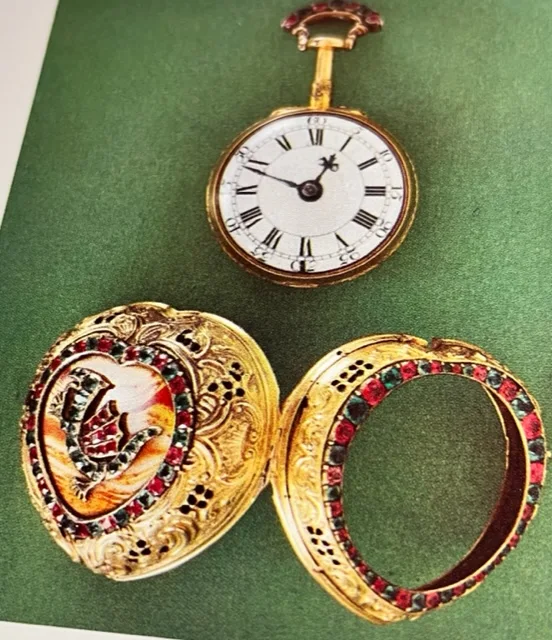
GOLD WITH PRECIOUS STONE, LADIES WATCH.
This heart-shaped dress watch has a quarter repeater movement by English maker Higgins, circa 1750. The gold outer case is decorated with an Agate heart-shaped band within a circle of Emeralds & Rubies. The Bezel is inlaid with the same precious Ruby stones.

The case is from XVIII-th Century dress watch, its movement is signed by Charles Cabrier of London. Its dated 1760-1799 and has a balance cock. The back depicts the Holy Family.


CHATELINE WITH GOLD CARNELIAN WATCH

GEORGIAN REPOSUSSE' GOLD WATCH
A scene of Joseph and his Brethren in the outer pair-case. which is in high relief repousse'.(ronde-bosse). London maker "Rivers and Son" produced this ornate watch in 1760. This watch and dial show a definite Dutch influence. Inside is an English letter hallmark of 1782.

Here is a close-up of the detailed engraving. (I thought that you would like to see more of this ornate engraving.)

London maker Thomas Gray produced the movement 1780-1790. The back if the watch case is decorated with pearls around a coral coloured center, made of a single, hollowed Carnelian, Bezel is surrounded by Pearls Chatelaine with gold tassels, and the key with intaglio.

CHATELAINE WITH WATCH IN GENEVA ENAMEL
This ornate (an elaborate, jeweled fob) carries a watch with a rare half-quarter repeater movement, signed by Benjamin Gray and Justin Vulliamy. This is dated 1750-1760 in London. The watch, with double Geneva-made case, and chatelaine are in gold, enameled & engraved. Attached is an watch key & hand-shaped amulet.

LOUIS XVI RING-WATCH
This man's gold ring-watch probably Geneva-made circa 1770. It has a cylinder escapement movement with repeater which chimes quarter hours on a hidden bell. The case of the solid gold ring is chased, repousse', and made to release bell sounds. The visible balance wheel is decorated with diamonds.


GEORGIAN GOLD PAIR-CASE WATCH

DIRECTOIRE SILVER DECIMAL WATCH.
Berthoud Freres of Paris produced the movement, circa 1793 of this calendar watch. Designed for the French post-Revolutionary era. It posts twelve-month year, thirty-day months and ten-hour days with hundred-minute hours, it's dial reflects the new decimal system. which lasted about one year.
It also shows the ten days of the Republican week, with their quaint and forgotten names. A small traditional dial synchronizes the classic twelve-hour cycles with the new ten-hour day,
Outer case of this watch, by Kenneth MacLennon. Circa 1780, has a painted portrait of a young man under a horn covering. This was one of the many attempts to wed color to metal without employing expensive and fragile enamel.


LOUIS XVI GOLD CAMEO WATCH
Le Roy of Paris signed this watch in 1790. Both front and back made Wedgewood blue cameo plaques, pearl encircled. The front shows Mercury and Venus.

SKELETONIZED DUMB-REPEATER
Elegantly fashioned for the sound-sensitive and even the deaf, this particular dumb-repeater by Henchez of Paris 1790. This provides for its hammer stokes to felt as concussions against the case edge. Watch frame is gold with crystal front and back. The crystal dial is painted in reverse, the back plate is entirely "skeletonized" to reveal the intricate movement from both sides.

FRENCH EMPIRE SELF-WINDING GOLD WATCH
This highly complicated self-winding watch by A.-L. Brequet of Paris, in 1820. is a so-called "Perpetuelle" and contains a Platinum rotor. It is an hour, quarter and minute repeater, it shows the phases of the moon. The silver, engine-turned dial has a center calendar hand and three eccentric subsidiary dials. Brequets tiny, but not secret signature and shop numbers are engraved on both sides of the watch.

PAIR OF "CHINESE" WATCHES.

One of the few "Chinese" watches seldom produced produced except "en double", these peach-shaped timepieces have movements, each with a duplex-escapement (escape wheel with two sets of teeth), signed by "Libery of London" circa 1800-1810.
In Geneva enamel cases, the painter, through his color graduations, has successfully simulated he shadings of the fruit itself. The bezel, gold-set leaves on the back, stems & crowns are studded with Pearls.

TRIPLE-CASE "TURKISH" DRESS WATCH.

As this watch was intended for the Orient, this watch has a protective triple-case in gold, decorated with Geneva enamel. The quarter repeater movement is by "Rundell and Bridge", London hallmarked in 1824. The inner case is pierced, engraved, painted with "Turkish" landscapes.


(This photo shows an enlarged area of the flint-lock mechanism).


GOLD AND ENAMEL DRESS WATCH

FRENCH RESTORATION PISTOL WATCH
This extraordinary gold and enamel automaton pistol watch with pomander and concealed in the butt. It is signed by Garrand circa 1820.
When the trigger is pressed a lotus flower springs from the barrel and then the pomander activates a perfume spray. The pistols barrel and body are enameled, Inlaid with gold and engraved. Cocking the flint lock reveals a trigger which bares the (Garrand) signature of the unknown maker. Workmanship is superb, perhaps by the fine Geneva shop "Fre'res Rochat".


GOLD AND ENAMEL AUTOMATION WATCH
The movement by "Piquet and Meylan" of Geneva, circa 1815. It is a musical and repeater type. It has numerous pearls adorning the outside edge. The figurines are of Titus and Berenice

The musical movement, with quarter repeater, of this French Restoration watch is by "Le Roy" of Paris, circa 1822-1825. The Crown, Bezel and pendant are in multicolored Geneva enamel. It has a champleve' enamel, and it has a contemporary enamel key as well.
.jpg)


VIENNESE MANDOLIN-SHAPED WATCH
.jpg)
FRENCH EMPIRE MANDOLIN-SHAPED WATCH
The music box and repeater gongs of this movement by "Piquet & Meylan" Geneva 1815-1820. "O du Liber Augustin" is the tune of the mandolin. The outside edge is covered with Turquoises.

GOLD AND ENAMEL DRESS WATCH
This ornate Geneva-made piece, circa 1820 contains a music box, and a golden automaton, representing musicians and a dancing child, when the door is opened.. There are golden strings along with enamel which is decorated with pearls and diamonds.

Franz Schiesel of Vienna, circa 1820 produced this mandolin-shaped watch with its fine gold case multi-colored enamel case. The moving balance is visible though a glassed window on the flat front of the mandolin. The rounded body of this instrument is hinged to reveal the enamel dial of a watch with fusee' and verge.

(This photo shows the opened watch, from being shown from the above view.)


EARLY XIX CENTURY FORM WATCH


SWISS MANDOLIN-SHAPED WATCH
The entire mandolin case of this watch, was made by "Monier et Fils", Geneva 1810. This is covered with blue and white enamel. Two Harlequins in high relief appear on the back, or "belly" of the mandolin.

This is the "up-close", front-view photo.

Here is the overall view, you can see the chain-strings of the mandolin.

An unknown French-Swiss maker created this gold filigree lyre "form" watch. (Form watches are those with a diversity of case shapes, apart from oval or circular). This one has a small elliptical movement with moveable, visible balance wheel, set with a row of pearls, and an early cylinder escapement. (there was no year inscribed, or noted on this watch)

FRENCH RESTRATION FORM WATCH

The maker of this lyre-shaped pendant watch, circa 1820-1825, is unknown. This case in four-color gold, is studded with Amethysts.

.jpg)

GOLD AUTOMATON WATCH

This is showing a view from the reverse. (outstanding stone-setting process)
.jpg)
GOLD AUTOMATON WATCH
Neuchatel hallmarks, circa 1825, appear on this Swiss piece. whose maker is unknown. The face has two enameled dials, the lower for hours and days of the month. The upper dial with enameled plaque showing Adam & Eve, with the Serpent revolving around them both to mark the seconds.

In the blue enamel face of this Swiss watch, circa 1825, a small hour and minute dial is set just above an automaton scene of workmen hammering and using a grinding wheel, moved by the repeaters arrangement. The gold case houses a thin movement of only 43 mm's in width.

(Here is a close-up of the very same scene. Even in those earlier days they we using grinding wheels as "WE" do today, interesting observation? I thought that you would like to see this.)


Here is another view.

GOLD AND ENAMEL "CHINESE" WATCHES


ULTRA-THIN XIX CENTURY POCKET WATCH
Swiss maker Phillipe Meylan may have signed the movement "P.M." for Robert Brandt & Cie., circa 1850-1860. The case, with finely wrought gold and enamel decoration, houses a skeletonized and extremely this cylinder escapement movement which uses a male key.


This pair of Swiss-made watches, circa 1820 for the Chinese market is richly enameled, and set with pearls. Movements are provided with ornamented parts, known to amuse the Oriental owners. Symmetry being preferred in the Chinese decorative arts. Timepieces from Switzerland and England for this market also came in pairs.
Infrequently used, they were exhibited on special occasions. matching pairs are, since European dealers obtaining them from China in the late XIXth Century often resold them from China in the late XIXth Century often resold them singly.

AMERICAN "DOLLAR" WATCH

This relic of the gaslight era is one of the famous watches produced by "R.A. Ingersoll & Brothers, Waterbury, Connecticut. and New York. circa 1890. The type became know as "The Watch that Made the Dollar Famous." It's key-wound & set with an attached key in the back.


AMERICAN CENTENIAL CELEBRATION WATCH
(Now honestly, can you tell me when this watch was made?) Please look carefully!
Even as a Canadian writer and editor, I knew that answer.
==========================================
This skeletonized metal watch is unsigned, but quite similar to those made by "Favre Jacot of Le Locie", Switzerland for the patriotic U.S. market during the American Centennial Celebrations. Within the "display" case, watch plates are cut in form of numerals to read "1776" (how quaint?)
Balance bridge is "1", center and third wheel bridges are the first "7", fourth and escape wheel bridge, the second "7", barrel bridge, the "6" .

The inside of the case is signed "Vacheron et Constatin" pf Geneva, circa 1830-1845. The gold case itself is finely painted in multicolored champleve' enamel, has a matching key, and houses a fine, thin movement. Dial rings have letters in lieu of numerals.


This is an up-close of the original Dress Watch from Louis Philippe. The inside of the case is signed "Vacheron et Constatin" of Geneva, circa 1830-1845. The gold case itself is finely painted in multicolored champleve' enamel, has a matching key, and houses a fine, thin movement. Dial rings have letters in of numerals.

=====================================================================
Finally, I've completed the selection of watches that appeared in this catalogue. I could have mentioned more, but suffice to say I've covered many of the most interesting watches that we featured. Hoping that you enjoyed how the watches came about. The description on each photo was not my own, I had to write and accept every detail as it was written by the catalogue authors. All I can say is the following words of praise.
"THANK YOU ROLEX WATCH U.S.A" for this wonderful 1974 catalogue.
These watches appeared on loan from the "Metropolitan Museum of Art in New York", "The Wilsdorf Collection of Geneva" & "Zale Collection of Dallas" and the "Benis Collection of New York. U.S.A."
Again, thank you for showing us how watches have evolved!...Gerry Lewy




.jpg)


